

Good morning,
Apparently nobody knows if Mitch McConnell, one of the 100 most influential elected officials in the country, is alive or not. That felt crazy to type.
First time reader? Consider subscribing (it’s free) 👇
Israel
During Kamala Harris’s ill-fated presidential run, a trend surfaced on social media. A vocal subsection of apparently engaged Democratic voters promised a protest vote — they would withhold their support for Harris due to her position on Israel’s military action in Gaza following the Hamas terrorist attack on October 7th, 2023.
At the time, I mentally scoffed at the idea. Were there really enough voters sharing this view that they could influence an election outcome?
Harris did lose. I don’t know how much those protest voters actually moved the final tally, but I can admit now they may have been ahead of a curve that is still bending.
New York Mayor Zohran Mamdani has been the most noteworthy vocal critic of Israel in American politics. His Muslim background drew question after question about Israel throughout his mayoral campaign — a topic that struck me as odd, given that a city mayor in America doesn’t exactly have much impact on US foreign policy at all.
During an early primary debate, candidates were asked where their first foreign trip as mayor would be. Every candidate answered Israel. But when it came to Mamdani, the moderator pivoted: did he, a Muslim candidate, support the Jewish state of Israel? His answer was careful, but hard to argue with.
“I believe Israel has a right to exist as a state with equal rights… I would not recognize any state’s right to exist with a system of hierarchy on the basis of race or religion.”
But the question posed to Mamdani begets a different one: why are candidates running for local and regional elections being asked about their views on a country on the other side of the planet?
Support for Israel in the US has a long history. For decades, the generation of our parents routinely espoused consistent, bipartisan support for Israel; a product of post-Holocaust moral clarity, Cold War alliance structures, and for some, on a biblical conviction.
But that consensus has seen a rapid decline following Israel’s leveling of Gaza, and the growing attention their outsized influence on American election cycles has received.
Only 9% of Americans under 35 approve of Israel’s military action in Gaza, and just 6% hold a favorable view of Benjamin Netanyahu. Six in ten Americans overall now hold an unfavorable view of Israel — up nearly 20 points since 2022. A March 2026 Pew survey found eight in ten Democrats and Democratic-leaning independents hold a negative view of Israel, up from 53% in 2022.
A June 2026 Quinnipiac survey found 48% of American voters now believe the US is “too supportive” of Israel. Among independents, that number rises to 55%. And 60% of Americans said the Iran war was “not worth it.” Perhaps most telling for the midterms: 41% of voters cited the Israeli-Palestinian conflict as a priority in their congressional vote.
That is a significant, non-partisan segment of the electorate now expressing deep scrutiny of a country that has received hundreds of billions in foreign aid since its establishment in 1948.
Political parties have taken notice of this shifting sentiment.
Long a niche political organization watching from the sidelines of the Democratic establishment, the Democratic Socialists of America (DSA) has in recent weeks won a string of primary victories that are reshaping what the Democratic Party’s next generation looks like. A year ago they had two members in Congress. After the last few weeks of primary elections, they are on track to have at least five.
DSA candidates Darializa Avila Chevalier and Claire Valdez won congressional primaries in New York, while in Colorado, 29-year-old Melat Kiros unseated Diana DeGette; a 15-term incumbent who had held her Denver-area seat since 1997.
The DSA’s platform across all these races has been (roughly): Medicare for All, affordable housing, higher taxes on the wealthy — and most relevant here—a staunch pro-Palestinian foreign policy.
It is a platform not wholly unique to the DSA. In Michigan, Abdul El-Sayed is running a contentious Democratic Senate primary against Haley Stevens. El-Sayed called explicitly for an arms embargo on Israel and criticized US involvement in the Iran war.
Not too long ago, I wrote briefly about a political idea called “Horseshoe Theory.” The concept holds that the political spectrum isn’t linear — left to right — but shaped more like a horseshoe. The further you travel toward either extreme, the closer those ends bend toward each other, overlapping in surprising ways.

Israel has become one of those issues found at the curved end of that horseshoe.
On the right, Israel has created a growing fracture in the Republican Party, splintering an old guard of conservatives who have avowed support, quite often on biblical grounds, for the Jewish nation.
Tucker Carlson, for years the most prominent narrative-setter for mainstream Republican views, has been one of the most vocal critics of US ties to Israel and Netanyahu’s influence on Trump’s foreign policy. His position seems driven by an “America First” logic that asks why American soldiers, American money, and now an American war in Iran are all being deployed in what he and others claim is service to another country’s interests. The MAGA base is asking the same question with increasing volume.
That tension produced one of the most remarkable political stories of this primary cycle. In deep red Kentucky, Republican Thomas Massie — who rose to broader notoriety through his push to release Epstein-related files — lost his primary to challenger Ed Guirallan. AIPAC and several other pro-Israel PACs funneled $9 million into Guirallan’s campaign. A single House seat, already safely Republican in a safely Republican state, became the most expensive House primary on record. Massie’s apparent sin was voting against foreign aid bills, which include aid to Israel.
And here is where I think people underestimate how distorting this is. While other countries spend more on registered foreign lobbying — Japan led in 2024 at $48.5 million, Saudi Arabia at $44 million — it is Israel’s domestic lobbying arm, AIPAC, that operates differently. AIPAC is not a foreign-registered lobby. It is an American organization, funded by American citizens, and therefore exempt from the Foreign Agents Registration Act.
That distinction allows it to operate at a scale that registered foreign lobbyists cannot: funneling money directly into individual congressional races, targeting specific candidates, and doing so with the full weight of a well-organized domestic Super PAC. 65% of Congress has received AIPAC funding. For 80 members, AIPAC is their single largest all-time contributor.
The nationalist “America First” principle at the heart of MAGA cannot comfortably coexist with an America that funds, profits, and seemingly goes to war at another country’s behest. An elected official whose platform and decision-making is shaped by the financial interests of a foreign government cannot be said to be reasonably fully representing their actual constituents.
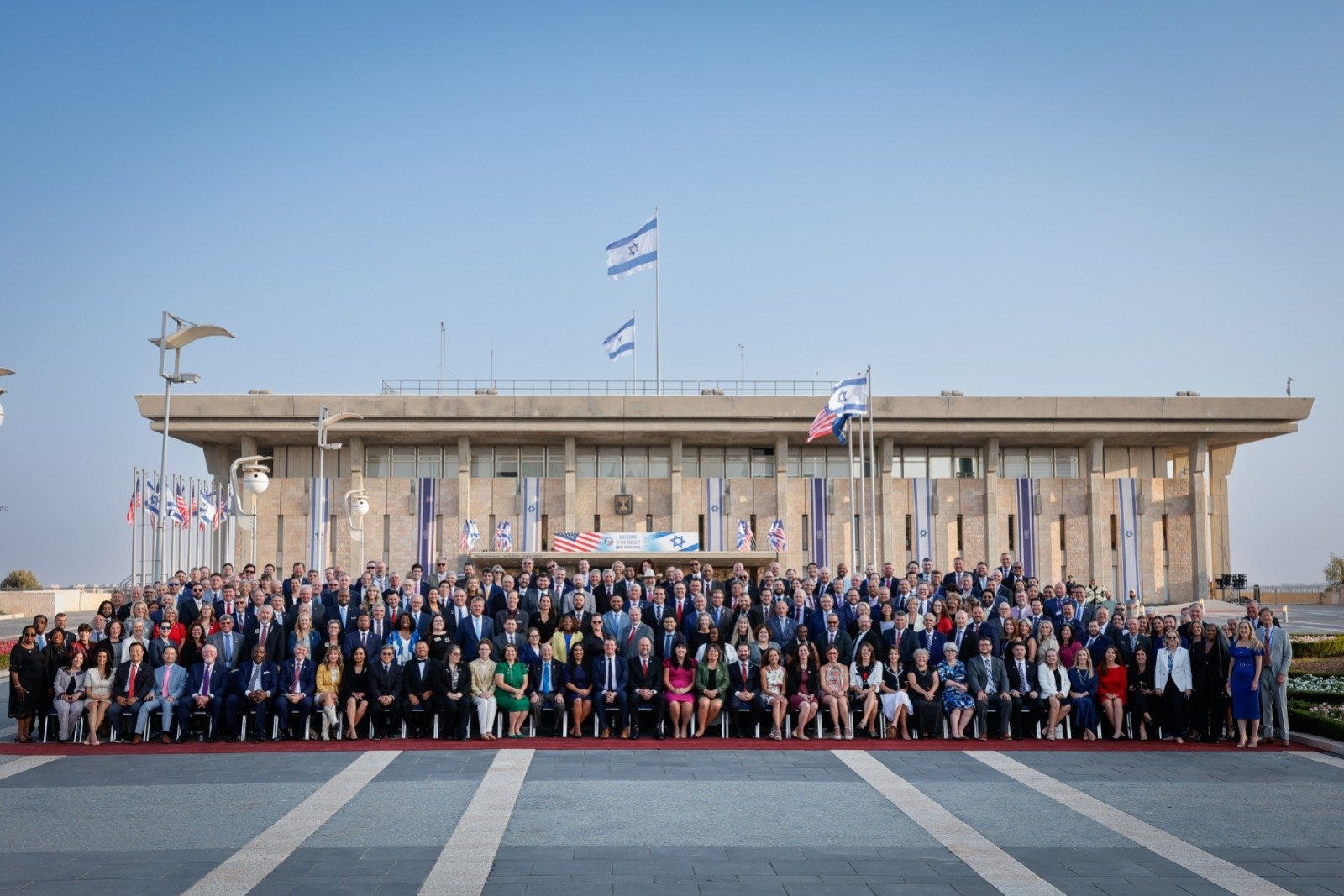
Israel sits at an important inflection point between several distinct but connected grievances driving our modern politics.
We’re living through an America divided by countless fractures — wealth inequality, inflation, a housing crisis, disagreements on immigration, and the role of religion in government. Beneath all of it runs an undercurrent of populist energy. It is no surprise then that a large, non-partisan consensus has formed on a set of issues where public opinion has already moved: money in politics, no foreign entanglements, the gap between what voters want and what funded incumbents deliver.
If you charted all those issues in a Venn diagram, Israel might just land near the center.
I don’t think criticizing this structure is antisemitic. I think it’s the same argument I’d make about the Saudi lobby, the defense contractors, or any other concentrated pool of money that purchases congressional deference for foreign interests over American citizens.
When you trace this pipeline — billions in military aid flowing out, millions of AIPAC lobbying dollars flowing back into hundreds of congressional races — and then hold that relationship up against a nation that systematically displaces people from their homes, restricts their movement, and kills thousands of children, how can you not scrutinize the ties?
Do not be confused; my critique is not of the Jewish people, their right to a peaceful existence, or their faith and identity. My critique is of a structure of power that is distorting our own democratic representation, and funding a military campaign that is killing innocent people along ethnic and religious lines. That is genocide, and our country is deeply intertwined in it.
The same argument I make about Israel and AIPAC is the same argument Thomas Massie makes, and the same argument the DSA makes, and the same argument Tucker Carlson makes — all for different reasons, but overlapping nonetheless (that is the horseshoe bending).